2026 OCP Global Summit: Record Growth, Open Innovation and the Future of AI Infrastructure
The 2026 OCP Global Summit brought 15,000 attendees to San Jose, California, October 12–15 — a 38% increase over the 10,835 who attended in 2025. With a sold out event, it was the largest Global Summit in the Open Compute Project’s history.
The event theme for OCP Global Summit 2026, “Scaling Innovation for the AI Era”, highlighted the unique perspective of the OCP Community that has been pervasive throughout its 15-year history: computing at very large scale. Delivering the data center and computational infrastructure for AI is simply an extension of computing at scale that the OCP Community already solves for Cloud data centers. Thus, the OCP Community’s model of collaboration to drive openness, efficiency, sustainability, scalability and impact will again be central to meeting the new challenges of extending data centre facilities and computational systems needed to handle massively parallel and distributed AI computations at a scale that have never before been imagined.
Program and Expo:
- 22 content tracks, 948 speakers and 578 sessions
- Innovation Village: 7 OCP project stations and 10 emerging-technology demos
- 4 Co-located workshops. See details here.
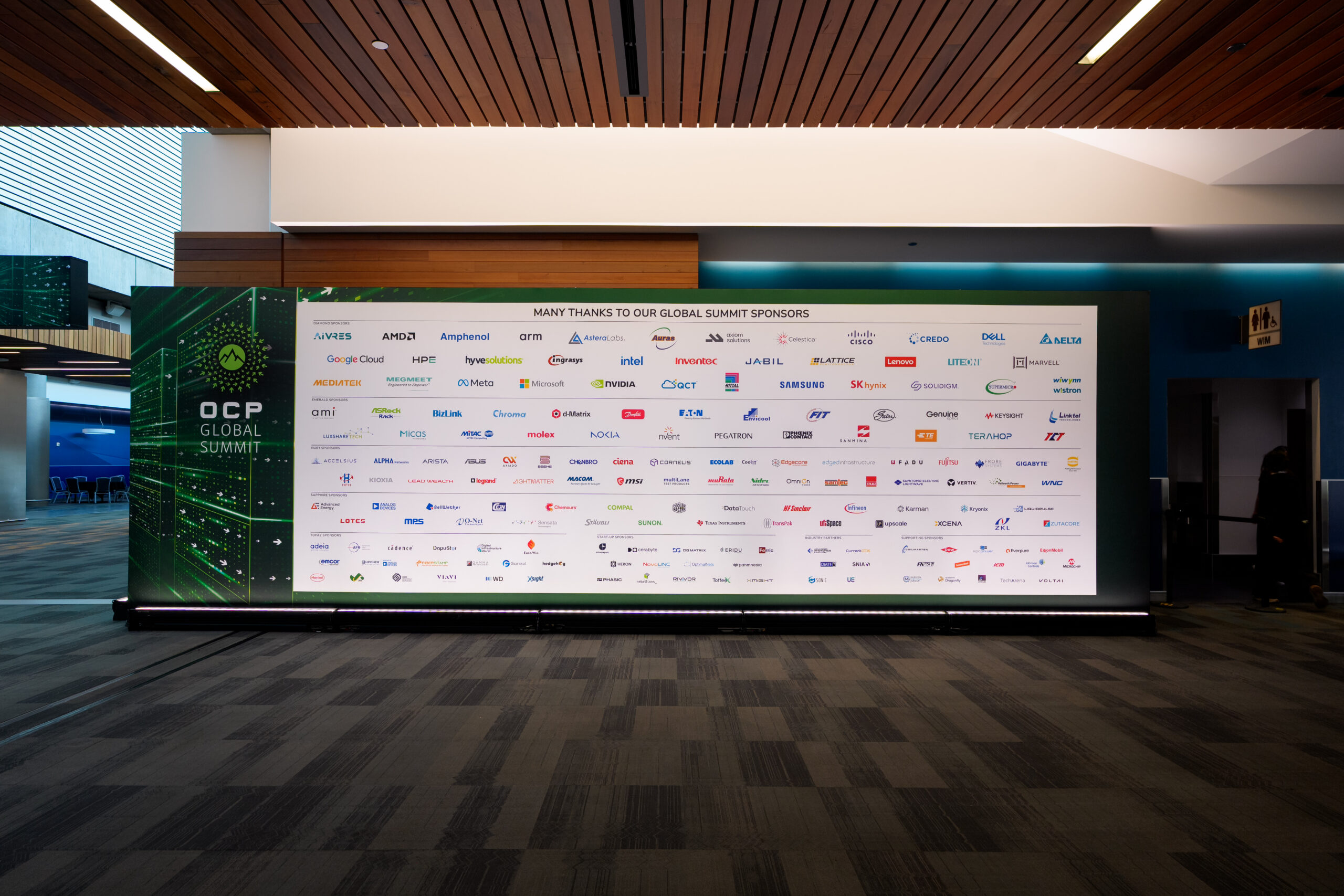
- 178 total sponsors with 158 booths across 2 exhibit halls
- 202 media and analysts representing more than 115 organizations
Future Technologies Symposium
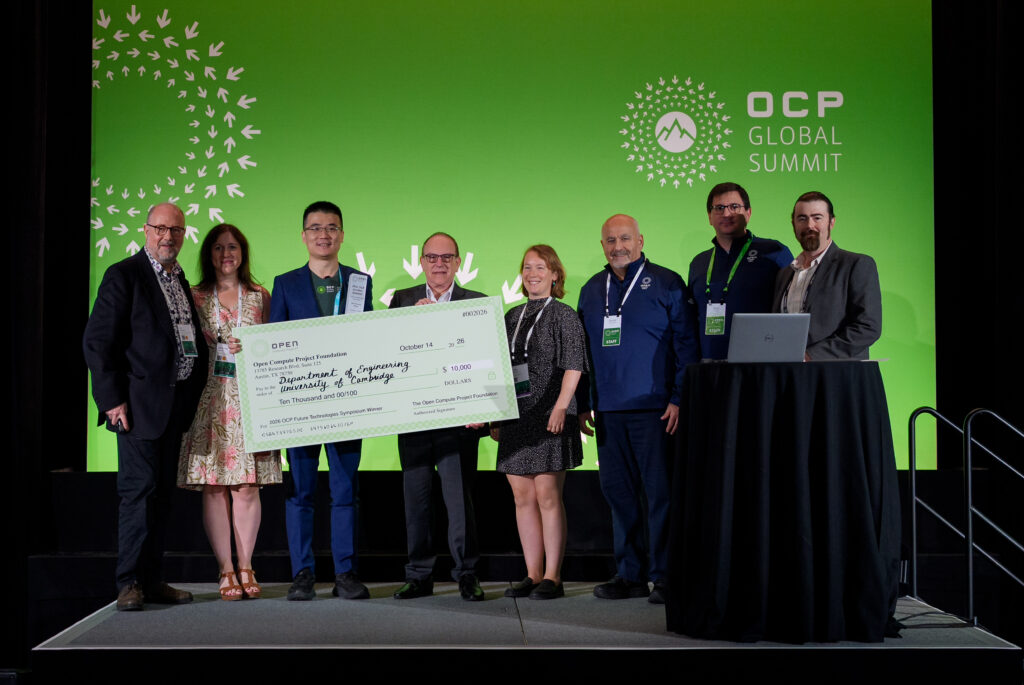
- Best FTS Paper and $10,000 prize: “Copper Sintering BGA Interconnect for Mitigating Electromigration in High-Current AI Power Delivery” by University of Cambridge
- Best Sustainability Paper: “Towards Sustainable AI Data Centers Through Direct Waste Heat Recovery Enabled by Membrane-Assisted Heat Sink Technology” by University of Florida and University of Maryland at College Park
- Best AI/HPC Paper: “Wavelength-Granular OCS with Solid-State OPA: Energy-per-Bit for AI Fabrics” by Shenzhen Litratech Co. Ltd. and Pixora LLC
Key Announcements:
The biggest story was the shift toward open, complete AI infrastructure: racks, networking, power, cooling, and security designed to work together. Some of the most significant announcements included:
- NVIDIA contributed Vera Rubin rack and compute-tray designs to OCP.
Through its MGX architecture, NVIDIA shared designs intended to give manufacturers a common foundation for next-generation AI factories. Its announcements also included open-source DSX components, networking collaborations, and power infrastructure work. Significance: greater ecosystem participation around NVIDIA’s next-generation infrastructure. NVIDIA announcement - AMD introduced Helion, an open rack blueprint for agentic AI.
Helion supports CPU-focused agent execution and configurations combining CPUs with GPU inference. AMD plans to contribute its specification to OCP, with partner configurations planned for November 2026. Significance: an open infrastructure approach tailored to AI agents’ broader computing needs. AMD announcement - Meta unveiled a substantial new open AI networking portfolio.
Announcements included IcePack, its first liquid-cooled networking rack; IceCube, a 102.4-Tbps switch platform; Flattened Planar Fabric; MetaRoCE; and the OSPA switch-platform initiative. Significance: shared building blocks for scaling AI networks across hardware and software. OSPA was announced shortly before the Summit, on October 8. Meta announcement - The ecosystem advanced practical specifications for megawatt racks and 800V DC infrastructure.
OCP reported progress on facility designs, power conversion, grid interaction, energy storage, and cooling. Microsoft highlighted its Mt. Diablo power architecture and Mt. Atlas heat exchanger reference architecture. Significance: addressing the facility constraints that increasingly determine how quickly AI capacity can be deployed. This was a major progress milestone for an initiative launched in 2025. OCP update, Microsoft update - Open Ethernet approaches made further progress for very large AI clusters.
Microsoft highlighted Multipath Reliable Connection, designed to support networks exceeding 100,000 GPUs with two network tiers. It also reported that the Ethernet for Scale-Up Networking community had released specification 1.0. Significance: stronger open alternatives for connecting increasingly large accelerator systems. Microsoft update - Microsoft, Marvell, and Oracle announced an open integrated hardware-security effort.
Their collaboration establishes specifications for server-integrated hardware security modules; Microsoft introduced the associated Tessera Integrated HSM open-source initiative. Significance: bringing protected cryptographic operations closer to workloads through a shared architecture. The specification remains under development. Marvell announcement, Microsoft details - Intel detailed its GPU D-series and new Xeon-based rack designs.
Intel disclosed additional information about the inference accelerator formerly called Crescent Island, alongside rack and software developments. Significance: additional options for building heterogeneous infrastructure around inference and agentic AI. Intel announcement - IDC raised its OCP infrastructure forecast to $800 billion annually by 2029.
That is approximately 2.7 times its previous forecast for the same year. The study projects $892 billion in 2030, representing approximately 51% of spending across the infrastructure categories measured. Significance: probably the strongest market-scale announcement for communicating OCP’s growing economic importance. These are forecasts, not realized spending. OCP/IDC announcement - OCP released evidence quantifying the value of participation.
Findings included approximately 5% lower average total cost of ownership, up to 15% faster deployment, and up to 30% shorter qualification timelines. Some hyperscale respondents reported 150× ROI; that figure should not be presented as a typical outcome. Significance: a more concrete business case for open collaboration. OCP study announcement, OCP LinkedIn summary - OCP launched Nexus, its AI knowledge assistant.
Nexus provides conversational access to specifications, reference designs, white papers, and Summit materials, with citations to supporting sources. Significance: making OCP’s accumulated technical knowledge easier to discover and apply. OCP launch announcement
Who Attended
Attendees represented more than 3,400 organizations from 64 countries. More than half (53%) were attending the Global Summit for the first time, and 141 came from academia.
| Region | Share of attendees |
|---|---|
| North America | 73% |
| Asia Pacific | 20% |
| Europe, Middle East & Africa | 6% |
| Caribbean & Latin America | <1% |
55.5% reside in California, with Texas representing the next highest domestic attendance at 9.5%.
Attendee Countries Represented
| Armenia | Australia | Austria | Belgium |
| Brazil | Canada | Chile | China |
| Colombia | Costa Rica | Croatia | Czech Republic |
| Denmark | Egypt | Estonia | Finland |
| France | Germany | Greece | Guatemala |
| Hong Kong | Hungary | India | Ireland |
| Israel | Italy | Japan | Korea, Republic of |
| Latvia | Lebanon | Luxembourg | Macao |
| Malaysia | Mexico | Monaco | Netherlands |
| New Zealand | Norway | Oman | Philippines |
| Poland | Portugal | Romania | Saudi Arabia |
| Singapore | Slovakia | South Africa | Spain |
| Suriname | Sweden | Switzerland | Taiwan |
| Thailand | Turkey | Ukraine | United Arab Emirates |
| United Kingdom | United States | Vietnam |
The attendee breakdown by organizational role was as follows:
- Technical Roles – 50.0%
- Engineer – 21.5%
- Technology Architect/Strategist/Management – 17.9%
- Research & Development – 5.0%
- Data Center Infrastructure – 5.6%
- Sales & Business Development – 22.7%
- Executive Leadership – 9.2%
- Marketing – 7.2%
- Operations & Administration – 5.5%
- Media & Analyst – 2.5%
- Academic – 0.6%
- Other – 2.2%
Media and Analyst Organizations
There were over 200 media and analysts present from the leading firms globally. including:
- Reuters
- Bloomberg
- Gartner
- IDC
- TIME
- WIRED
- Omdia
- SemiAnalysis
- Dell’Oro Group
- TechInsights
- TrendForce
- Counterpoint Research
- Futurum
- EE Times
- DIGITIMES
- VentureBeat
- ServeTheHome
- Data Center Frontier
- 650 Group
- LightCounting
Attendee Interest Areas
| AI | 61.5% |
| Cooling | 31.7% |
| New Technology | 25.7% |
| DC Facility | 22.9% |
| Networking | 21.9% |
| Rack | 18.9% |
| Server | 15.1% |
| Hardware Management | 12.7% |
| Silicon | 11.7% |
| Cloud Management | 9.7% |
| Edge Computing | 8.3% |
| Storage | 6.7% |
| Test and Validation | 5.1% |
| Sustainability | 4.5% |
| Security | 3.8% |
| Enterprise Network | 3.6% |
| Telecom | 2.6% |
| Time Appliances | 0.4% |
Helpful Links
- Find the recordings and slides from all Summit sessions here.
- Summit photos can be found here.
- Information on 2027 sponsorship can be found here.
- OCP Membership information can be found here.
Save the Dates
Beginning in 2027, the annual OCP Global Summit is moving to a new location! The OCP Global Summit will move to the Moscone Center in downtown San Francisco, California, marking an exciting new chapter for our global event and Community. Read the full announcement here.
- 2027 OCP Global Summit: October 4–7, 2027
- 2028 OCP Global Summit: Sept. 25–28, 2028
- 2029 OCP Global Summit: Oct. 15–18, 2029
- 2030 OCP Global Summit: Sept. 30–Oct. 3, 2030
Thank you…
To our attendees, speakers, sponsors, media and community volunteers who made the 2026 Global Summit our biggest yet, and a special thank you to our event production partner, FNTECH. We’ll see you in 2027!
To Dave Sims Media for the video production. Learn more here: davesimsmedia.com