Podcast Episodes
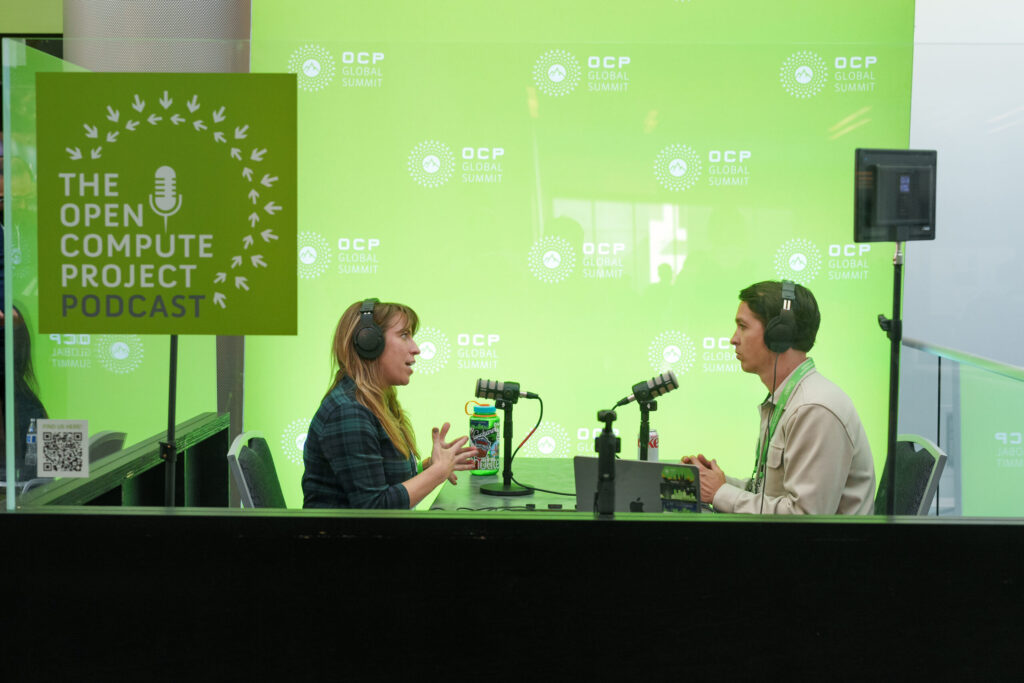
Join host Rob Coyle of the Open Compute Project, a foundation focusing on open source designs and specifications. With the Open Compute Project podcast, Rob aims to engage with the global community dedicated to developing efficient designs for scalable computing.
Listen in as we discuss data centers, IT hardware, and infrastructure through expert interviews and insightful analysis to empower listeners with the knowledge to make informed decisions and deepen their understanding of the OCP.
Your feedback shapes our content, so tune in, engage with our community, and be a part of reshaping hardware technology.
View all OCP Podcast episodes on the platform of your choice:



Building Real Confidence in Chiplet Stacks with Evelyn Landman of proteanTecs
Episode 23
Chiplets aren't just a trend anymore, they're becoming the default architecture for the AI era. But as the industry stacks more dies into a single package to keep up with AI and HPC demands, it's inheriting a reliability problem nobody has fully solved: when four, eight, or more dies from different processes (and sometimes different vendors) share one package, a single weak link can disqualify the entire stack — and the cost of that failure is enormous.
In this episode, OCP's Rob Coyle sits down with Evelyn Landman, co-founder and CTO of proteanTecs, to unpack why "known-good-die" testing is no longer enough and what it actually takes to reach "known-good-stack" confidence. They get into the hidden risks of multi-die packaging — thermal coupling, voltage droop, mechanical stress from through-silicon vias, and interface faults that traditional pass/fail testing simply can't catch — and how embedded telemetry is giving engineers real visibility inside the package, from bring-up and debug all the way through in-field operation.
Interested in the chiplet ecosystem? Reach out to Evelyn and the proteanTecs team, and get involved with the Open Chiplet Economy work stream at the Open Compute Project.


- Why AI, HBM, and co-packaged optics are forcing the move to multi-die packages
- How "shift-left" testing catches faults before you commit to an expensive package
- Mix-and-match and binning: building a more consistent, higher-performing stack
- What embedded telemetry reveals that lab-condition pass/fail testing misses
- Real-time actuation and fleet-level predictive maintenance in the field
- How power and thermal insight extends useful life across data centers, automotive, and physical AI
- The role of OCP's Open Chiplet Economy in moving from siloed integration to open, interoperable chiplet operations
- 00:00Intro: chiplets as the default AI-era architecture
- 01:11What's pushing the industry to modular dies
- 03:22The hidden cost: the problem shifts to the package
- 04:56Shift-left: catching faults before you package
- 05:28Single-die pass/fail vs. multi-die reality
- 07:25Where reliability breaks down in the field today
- 10:06What "known-good-stack" confidence looks like
- 12:20Mix-and-match and binning before assembly
- 15:37Embedded telemetry vs. traditional pass/fail
- 17:30Thermals, hotspots, and heat-sensitive optics & memory
- 19:54Real-time actuation to prevent imminent failure
- 20:59Board- and fleet-level predictive maintenance
- 24:43Scaling to millions of devices, tighter margins
- 27:16OCP's Open Chiplet Economy & the road ahead
- Evelyn Landman
Beyond Immersion – Delivering AI Outcomes with Jean-Marc Denis
July 14, 2026 • Episode 22
What if the biggest constraint on the AI era isn't compute power, software, or even money, it's how we cool the hardware that runs it all? In this episode, Rob Coyle sits down with Jean-Marc Denis, Chief Product Officer at Submer, to explore why immersion cooling has gone from an exotic idea in a Barcelona garage eleven years ago to what many believe will be the dominant cooling paradigm for AI infrastructure.
Jean-Marc brings nearly 40 years of high-performance computing experience — from designing supercomputers to founding the European Processor Initiative — to a sweeping conversation about intelligence per watt, the power and water constraints reshaping data center strategy, and why the real money in AI is not in training mega-models but in inference at the edge.
This episode covers both the technical and business dimensions of the AI infrastructure buildout, including why the six-month land-to-first-token expectation is forcing a co-design revolution, and how immersion cooling's simplicity — not its complexity — may be its most underrated advantage.
- Why the AI era has shifted the core efficiency metric from raw compute performance to tokens per watt and intelligence per watt
- How immersion cooling's power overhead advantage — from a PUE of 1.3 down to as low as 1.02 — translates to dramatically more compute capacity within the same power envelope
- Why power availability, not cost, is now the binding constraint — and how that changes the calculus for data center operators at every scale
- The community pushback on large data centers and why immersion cooling's zero water usage is a strategic asset for permitting and local acceptance
- The difference between greenfield and brownfield deployments and why investors are now demanding a path from land to first token in six months or less
- Why the edge is where the real AI enterprise money is — and why inference at the edge demands a fundamentally different infrastructure philosophy than training at hyperscale
- How immersion cooling compares to direct-to-chip liquid cooling in terms of maintenance complexity — and why the comparison has flipped
- Submer's co-design approach: turnkey nano, micro, and mini data center solutions from a few kilowatts to 100+ megawatts, designed around usage model first
- Why the Cambrian explosion of inference AI engines makes cooling flexibility — not optimization for one chip — the most important infrastructure property going forward
- 0:00Introduction - Meet Jean-Marc Denis, CPO of Submer and HPC Pioneer
- 0:53Submer's Story - From Barcelona Garage to Immersion Cooling Mainstream
- 3:59Intelligence Per Watt - How AI Redefined the Efficiency Metric
- 9:54Power Constraints at Scale - What PUE 1.02 Means at 1 Gigawatt
- 13:26Water, Permits, and Community Acceptance - The Hidden Advantage of Waterless Cooling
- 20:02The Maintenance Myth - Why Immersion Is Now Simpler Than Direct-to-Chip
- 24:24Co-Design and the 6-Month Data Center - Land to First Token
- 28:03The Inference Edge Opportunity - Where the Real AI Enterprise Money Is
- Jean-Marc DenisJean-Marc Denis is the Chief Product Officer at Submer, the Barcelona-based immersion cooling company he joined in November 2024. He brings nearly 40 years of high-performance computing experience, including designing large-scale supercomputers, building an HPC organization from zero to a top-four global ranking, founding and chairing the European Processor Initiative, and launching a microprocessor design company. He has also taught supercomputer and microprocessor architecture at the university level. At Submer, Jean-Marc leads the product organization with a conviction that immersion cooling — combined with an AI computing continuum philosophy — represents the defining infrastructure architecture for the next generation of AI deployment, particularly at the enterprise edge.
The EMC Testing Challenge: Why AI Infrastructure Is Outpacing the Labs That Certify It
June 5, 2026 • Episode 21
Every AI server rack deployed in a data center must pass electromagnetic compliance (EMC) testing before it can go live - it is a legal, regulatory requirement enforced by the FCC. But as AI hardware scales to megawatt-class racks with disaggregated compute, power, and liquid cooling systems, the test labs responsible for certifying that hardware are falling dangerously behind. There are only one or two labs in the world currently capable of handling the size, weight, and power demands of today's AI rack configurations - and the gap is widening with every new product generation.
In this episode, Jaswanth Vutukury - Lead EMC AI Hardware Infrastructure Engineer at Meta - joins host Rob Coyle to break down exactly why this bottleneck exists, what it means for hyperscalers and ODMs trying to bring next-gen AI infrastructure online, and why he is using the OCP podcast as a call to action: for test labs to join the OCP ecosystem, for hyperscalers to begin collaborating on the problem, and for the industry to explore alternatives to traditional testing before this becomes a hard stop on AI deployment.
- What electromagnetic compliance (EMC) testing is, why it is legally required, and what failure looks like in a real data center environment
- Why AI rack infrastructure - with disaggregated compute, power, and liquid cooling across multiple racks - presents an entirely different testing challenge than traditional IT equipment
- The three specific bottlenecks breaking the current EMC testing model: weight and turntable capacity, power delivery (1MW+), and physical chamber size
- Why there are only 1-2 labs globally capable of testing today's AI rack configurations - and the scheduling crisis this creates for the entire industry
- Why the problem is structurally self-perpetuating: AI rack cycles run 12-18 months, but building or upgrading an EMC lab takes about a year - with no sign of the pace slowing
- Jaswanth's direct call to action for EMC labs, hyperscalers, and ODMs - and why OCP is the right forum to bring all parties together
- What alternatives to physical testing - including simulation - may need to be explored as the industry works toward a longer-term solution
- 0:00Introduction - Meet Jaswanth Vutukury, Lead EMC AI Hardware Infrastructure Engineer at Meta
- 0:33What Is EMC Testing and Why Does It Matter? The 30-Second Explainer
- 2:00Why AI Infrastructure Is Different - Scale, Speed, and the Widening Lab Gap
- 5:01Inside the Bottleneck - Weight, Power, and the Chamber Size Problem
- 11:33Real-World Impact - Only 1-2 Labs Globally, and Everyone Is Competing for Them
- 21:20The Path Forward - Bringing Labs into OCP, Industry Collaboration, and What Comes Next
- Jaswanth VutukuryJaswanth Vutukury is the Lead EMC AI Hardware Infrastructure Engineer at Meta, where he oversees electromagnetic compliance testing and certification for AI server rack infrastructure. His background spans multiple hardware-intensive industries - including autonomous vehicles and consumer electronics - giving him a uniquely broad perspective on why the AI infrastructure EMC challenge is unlike anything the industry has faced before. He came to the OCP podcast with a clear message: the bottleneck is real, the timeline is short, and the solution requires the industry to move together.
Challenges, Metrics, and Allies in Women in OCP with Shruti Sethi
March 5, 2026 • Episode 20
In this second installment of the Women in OCP series, host Rob Coyle goes deeper with Shruti Sethi, Sr. Product Manager on Azure Storage at Microsoft, OCP Sustainability Steering Committee rep, and Women in OCP Co-Lead.
Where Part 1 covered the founding and structure of the group, this conversation digs into the harder questions: the real challenges the initiative faces, how it measures progress, what it will take to scale, and, critically, why male allies and non-women supporters are not just welcome, but essential. Shruti's perspective bridges her sustainability work with Microsoft Azure and her leadership at Women in OCP, making this a rich and candid conversation about what meaningful inclusion actually looks like in the data center industry.
- The real operational challenges of running a geographically distributed community - and how Women in OCP is adapting
- Why keynote abstract submissions are the most tangible, front-and-center metric for measuring women's representation at OCP Global Summit
- How Women in OCP tracks membership growth as a leading indicator of community health (230+ members and climbing)
- Plans to collaborate with external women's groups such as Women in Tech and Women in Mission Critical
- Why scaling across all OCP technical domains - networking, security, sustainability, cooling, and more - is a deliberate priority
- A clear and direct message: Women in OCP is open to all supporters, regardless of gender
- How the group plans to build internal alliances with OCP domain sub-groups to ensure representation across the board
- 0:00Introduction - Meet Shruti Sethi, Microsoft Azure PM and Women in OCP Co-Lead
- 1:00Real Challenges - Geography, Virtual Events, and Bridging the Personal Connection Gap
- 2:59Representation on Stage - The Keynote Abstract Problem and How to Fix It
- 6:34Measuring Impact - Membership Growth, Summit Momentum, and Key Metrics
- 7:58What's Next - External Partnerships, Industry Collaboration, and Scaling Across OCP Domains
- 12:15Allyship and Open Invitation - Why Women in OCP Welcomes Everyone
- Shruti SethiShruti Sethi is a Senior Product Manager on the Azure Storage team at Microsoft, where her work centers on the intersection of cost efficiency and carbon efficiency - end-to-end environmental and economic impact across cloud infrastructure. At OCP, she serves on the Sustainability Steering Committee and is Co-Lead of Women in OCP alongside Sung Kim of bp Castrol. Shruti brings a systems-level perspective to both her technical product work and her community leadership, approaching inclusion as an industry-wide challenge that requires cross-organizational solutions.
Building Community and Breaking Barriers: Women in OCP with Sung Kim of bp Castrol
February 27, 2026 • Episode 19
In this episode, host Rob Coyle sits down with Sung Kim, Global Head of Technology for Data Center Liquid Solutions at bp Castrol and Co-Lead of Women in OCP, to discuss how a simple observation at an OCP summit sparked a thriving initiative that is reshaping how women are represented across the data center industry.
From founding the Women in OCP group to hosting its first Women and AI luncheon co-sponsored by Nvidia and Lenovo, Sung shares the journey, the challenges, and the collective energy that is driving real change at the industry level.
- How Women in OCP was founded and why the timing was right
- The mission to address gender representation at the industry level - not just within individual companies
- How the group is structured, governed, and organized through a bi-weekly planning committee
- Key events including the Global Summit breakfast, regional networking sessions, and the Women and AI luncheon
- Insights from community feedback: mentorship programs, safe spaces vs. inclusive allies, and geography as a challenge
- Plans for 2026 including expanding mentorship and regional chapters
- How to get involved and subscribe to Women in OCP updates
- 0:00Introduction - Meet Sung Kim, Global Head of Data Center Technology at bp Castrol
- 0:33What Is Women in OCP? - Origin Story and Why It Was Needed
- 1:44Mission and Goals - Driving Industry-Level Inclusion Across the Value Chain
- 3:38Structure, Events, and Community Building - How the Group Operates
- 6:23Challenges and Surprises - Geography, Feedback, and Navigating Inclusion
- 9:08Successes, Looking Ahead, and How to Get Involved with Women in OCP
- Sung KimSung Kim is the Global Head of Technology for Data Center Liquid Solutions at bp Castrol, where she oversees product development, research, testing, and technical partnership activity across a global team spanning the United States, Europe, and Asia-Pacific. At OCP, Sung serves as a Sustainability Co-Lead and is the founder and Co-Lead of Women in OCP, a community initiative dedicated to increasing the visibility, representation, and leadership of women across the data center and technology industry.
Solving Data Center Demands: Australia’s Macquarie and OCP
January 6, 2026 • Episode 18
Rob Coyle sits down with David Hirst, CEO of Macquarie Data Centres, for a deep look at the rapid changes shaping data centers in the age of AI. David shares why Australia’s sovereign approach matters, how AI workloads are shifting design from “real estate” to “chip-out thinking,” and why early collaboration across hyperscalers, government, and the supply chain is becoming essential.
They explore the unique nature of the Australian market, the rise of liquid cooling and megawatt-per-rack designs, what it takes to build IC3 Super West, and how culture, regulation, and geopolitics all influence where and how AI infrastructure gets built.
A thoughtful conversation for anyone working in AI infrastructure, colocation, hyperscale strategy, or global data centre planning.
Content coming soon.
- 00:00Introduction
- 00:27Why Australia Is a Prime Data Centre Hub
- 01:52How AI Changed Everything
- 03:23Planning for Bursty, Unpredictable AI Workloads
- 04:28Liquid Cooling and Blurred Boundaries
- 06:17What Makes the Australian Market Different
- 08:35Building in Dense Cities and Working With Communities
- 10:12AI, Culture, and Data Sovereignty
- 11:22Local Requirements and Power Challenges
- 12:57Long-Term Operators vs Short-Term Developers
- 16:20Compliance as a Market Advantage
- 18:45The Critical Role of Data Centres in Modern Life
- 20:22Inside IC3 Super West
- 21:56Designing for a Fast-Changing Future
- 23:51Why AI Behaves Differently Than Cloud
- 26:43The Rise of CDU Innovation
- 28:09Building for 2030 and Beyond
- 33:27What Keeps David Optimistic
TI and the Future of AI Power: Smarter Systems from Grid to Gate
November 21, 2025 • Episode 17
Texas Instruments is known for semiconductors, calculators, and decades of design expertise. In this episode, Chris Suchoski shows how TI is becoming a full grid-to-chip partner for the next wave of data center growth. Rob and Chris break down what it takes to power AI, how architectures are shifting, and why TI’s deep experience outside the four walls of the data center matters now more than ever.
Chris outlines the pressure facing the industry. AI workloads are growing at a rate the traditional design cycle cannot match. Time-to-market has gone from years to months, yet the expectations for density, power, sustainability, and reliability continue to climb. TI’s response is to support the entire power path from the grid to the GPU. Their goal is to help customers move faster and build systems that can take on the new wave of compute demand.
They discuss the shift from conventional rack design to high-voltage architectures like 800V, the rise of megawatt-class racks, and what happens when unpredictable AI workloads collide with an aging set of power assumptions. Chris explains why this shift impacts every part of the ecosystem, from AC distribution to cooling to storage systems. He also talks through how TI’s decades of work in automotive, industrial, and grid power translate directly into the needs of hyperscale and AI operators.
The conversation also highlights how collaboration through OCP speeds progress. Standards development, shared learning, and early visibility into architectural trends help companies build aligned solutions. Chris explains why TI participates heavily in OCP working groups and why he sees it as one of the best ways for operators and engineers to keep up with rapid change.
Content coming soon.
- 00:00Introduction
- 01:00Meet Chris Suchoski and TI’s data center focus
- 03:00Why timelines are shrinking
- 04:00AI workloads and unpredictable power demand
- 06:00TI’s role beyond the compute tray
- 08:00Grid-to-chip: TI’s end-to-end approach
- 10:00Lessons from automotive and grid power
- 12:00Why OCP collaboration matters
- 14:00The shift to 800V architectures
- 17:00What Gen4 power architectures may look like
- 19:00Cooling, reliability, and emerging risks
- 21:00TI’s latest hardware and reference designs
- 24:00Hidden bottlenecks and future challenges
- 26:00What operators and engineers should prepare for
- 28:00 How to engage with TI and get involved in OCP
Power Must Change or Data Centers Stall w/ J.P. Buzzell
November 17, 2025 • Episode 16
AI clusters are exploding in size and pushing the limits of today’s data center power and network designs. In this episode, host Rob Coyle sits down with JP Buzzell, VP and Data Center Chief Architect at Eaton, to break down why power architecture has become the next big bottleneck and how the industry can respond.
JP explains how data center design has hit a turning point. Density jumped from a few kilowatts a rack to more than 100 kW almost overnight. The move from many small, varied workloads to massive, synchronized GPU clusters has changed everything from physical layouts to network physics. Packet loss now dictates rack layout. Space inside the rack has run out. Cooling had to evolve not just for efficiency, but simply to fit the gear. And power distribution needs a complete rethink.
The conversation covers the shift toward direct current power, why AC inside the rack cannot scale to the clusters coming next, and the role OCP is playing in driving standards, regulation, and cross-industry cooperation. JP also shares the human motivation behind this work, from medical breakthroughs to a cleaner, safer grid.
This is a clear and practical explanation of a topic that will shape the future of data centers for years to come.
Content coming soon.
- 00:00Why data center design is changing
- 02:15The jump in rack density
- 04:20Liquid cooling’s real driver
- 06:50Power congestion inside the rack
- 08:30JP Buzzell’s background
- 10:45Building hyperscale GPU clusters
- 14:40The power bottleneck hits
- 18:00Training vs inference reliability
- 20:40We’re still in the “light bulb era” of AI
- 22:10What slows DC adoption
- 25:00Inside the OCP power distribution effort
- 29:30Grid stability and load drops
- 34:00Modular power and offsite build
- 38:45The next wave of power tech
- 41:00Global standards and interoperability
- 51:55Final message: feed the good wolf
Educating the Future: Nomad Futurist’s Global Mission with Data Center Talent
November 1, 2025 • Episode 15
Nabeel Mahmood returns to the OCP Global Summit — and the OCP Podcast — with momentum, mission, and a message. In this follow-up conversation with host Rob Coyle, Nabeel shares the growth of Nomad Futurist’s education efforts, bringing students and new voices to the forefront of the data center ecosystem.
The episode dives deep into why building the future of infrastructure starts with people, access, and understanding. From debunking misconceptions about data centers to spotlighting programs supporting students in underserved regions, Rob and Nabeel explore the true meaning of open innovation and industry responsibility.
Content coming soon.
Humble Beginnings to Now: An interview with Bill Carter, Fellow Emeritus of the OCP Foundation
July 25, 2025 • Episode 14
In this special episode of the Open Compute Project Podcast, host Rob Coyle sits down with Bill Carter, Fellow Emeritus and former CTO of the OCP Foundation, for a deep and personal conversation spanning the entire history of OCP - from its scrappy beginnings to its position today as a force in global infrastructure innovation.
- The Birth of OCP: How Facebook, Intel, and Rackspace sparked a hardware revolution in a curtained-off corner of a San Jose colo.
- Vanity-Free Computing: The story behind the radical idea that simplicity, not flash, drives scale.
- Rack to Reality: The evolution of Open Rack - from triple-bus bar designs to a global standard reshaped by collaboration.
- White Box Networking Breakthroughs: Why disaggregated switches became one of OCP’s most disruptive contributions.
- Collaboration Over Competition: The unlikely alliances between rivals like Intel and AMD that propelled early specs like Decathlete and Roadrunner.
- Specs That Stuck - and Some That Didn't: Bill breaks down the difference between thriving standards and those that fell flat.
- OCP’s Global Footprint: What Europe and Asia bring to the future of open hardware, sustainability, and sovereign tech.
- What’s Next: Lessons from the past and a look forward at where OCP is headed - especially in the AI, modular, and liquid-cooled future.
- 00:00:00Intro
- 00:02:36The Birth of OCP: Why Facebook broke away from traditional server designs
- 00:08:44Bill Joins the Movement: How Intel became an early OCP catalyst
- 00:22:13Network Disaggregation: The white box switch that shook the industry
- 00:28:49Decathlete & Roadrunner: Competing specs, shared goals
- 00:34:12OCP Inspired vs Accepted: What it means and why it matters
- 00:43:10The Power of Connector Standardization: Dripless and universal quick disconnects
- 00:50:05Modular Momentum: The rise of DCM and the value of early collaboration
- 01:02:08What's Next for OCP: AI, sustainability, and global community growth