
Focus Domains
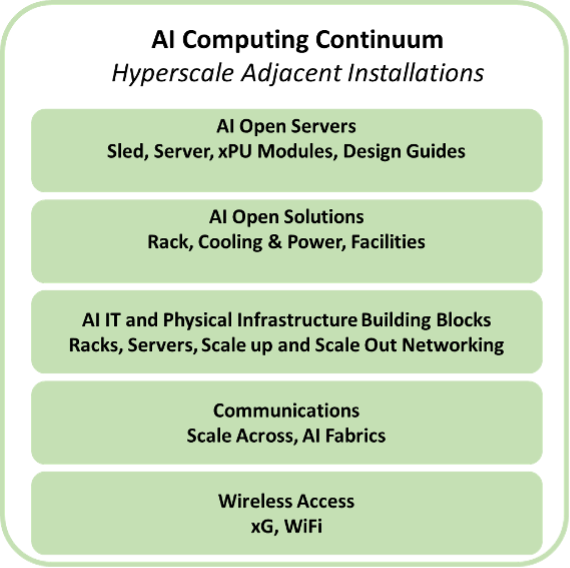
1. AI Open Server Architectures
This area defines the foundational building blocks used within AI-capable hyperscale-adjacent racks and multi-node systems. It includes:
- AI-optimized server and sled form factors designed for accelerated compute configurations
- Expansion modules that support heterogeneous accelerators and fabric topologies
- Mechanical, electrical, and thermal interfaces required to standardize server-level integration within diverse rack environments
- Design guidance for hyperscale-adjacent GPU/accelerator deployments, including airflow, power distribution, and serviceability
This domain ensures that server-level components remain interoperable, interchangeable, and portable across varied hyperscale-adjacent deployment environments.
2. AI Open Solution Architectures
This area defines the hyperscale-adjacent rack- and facility-aware system context required to deploy AI infrastructure beyond hyperscale data centers. It includes:
- Rack and system-level architecture — AI-specific rack enclosures and sub-rack form factors; rack and partial-rack AI system designs suited for modular deployment; in-rack networking and interconnect topologies supporting accelerator fabrics
- Cooling and power — air-cooled, closed-loop liquid cooling (CLLC), and hybrid cooling solutions ready for heterogeneous hyperscale-adjacent site conditions; power delivery, budgeting, and distribution frameworks aligned with modern AI workloads
- Deployment and facility considerations — accommodation of site constraints (power availability, cooling capacity, floor loading, acoustic and environmental restrictions); industrial and retrofit deployments, including sealed or ruggedized IP-rated enclosures; modular deployment models such as “pay as you grow,” rack-and-stack, and non-greenfield integration
This domain ensures that AI systems can be deployed consistently across colocation, enterprise, industrial, telco points of presence, and remote environments.
3. AI Building Block Architectures
This area defines the reusable hardware and infrastructure modules that serve as the basis for scalable AI system construction. It includes:
- Rack and sub-rack enclosure building blocks for consistent physical and mechanical integration
- Cooling modules (air, liquid, hybrid) with standardized interfaces
- Networking and interconnect modules for both intra-rack and inter-rack connectivity
- Power distribution and conversion modules tailored for inference AI loads
These building blocks form a standardized toolkit that supports both hyperscale-adjacent scale-up and scale-out AI designs while maintaining interoperability across vendors and facility types.
4. Autonomous AI Wireless Access
This area defines an AI-accelerated autonomous wireless access open hardware radio unit for xG or WiFi. It includes:
- Autonomous Radio (AuRU) design and implementation, including augments to manufacturing processes
- Radio Abstraction Interface (RAI) and the containerization of apps that can run in the radio unit environment
- Security Control Module (RU-SCM) and the application of security best practices to a radio unit of aggregated parts
This domain ensures that AI-accelerated wireless access systems can be deployed consistently across OpenRAN environments.
5. Connectivity
- Scale-across communications between data centers
- AI fabrics
Resources
This Project is open to the public and we want to welcome all those who would like to be involved.
Disclaimer: Please do not submit any confidential information to the Project Community. All presentation materials, proposals, meeting minutes and/or supporting documents are published by OCP and are open to the public in accordance to OCP’s Bylaws and IP Policy. This can be found on the OCP OCP Policies page. If you have any questions please contact OCP.
Documents
- Charter
AI Computing Continuum aims to accelerate the adoption of scalable, interoperable, and sustainable AI systems beyond traditional hyperscale data centers by defining open, modular infrastructure standards that work across diverse hyperscale adjacent environments—including regional colocation, enterprise on premises, telco points of presence, and industrial sites. Guided by OCP principles of openness, efficiency, and sustainability, the project focuses on leveraging hyperscale data center innovations to develop community-driven, hardware-focused specifications that enable hyperscale adjacent scale AI deployments covering scale up, scale out, scale across, and wireless access communications. By standardizing core platform building blocks, bridging the gap between hyperscale and enterprise needs, and addressing real-world constraints in power, thermal, and physical footprints, the AI Computing Continuum initiative supports repeatable, cost-effective deployment of advanced AI compute systems wherever they are needed outside of the centralized hyperscale data centers.
Recordings from Past Calls
To be added as the new project begins
Specs and Designs
Link to the Specs and Designs page (none yet)
Regular Project Calls
This project meets the 3rd Tuesday of every month at 12PM Pacific Standard Time. This call is open to the public (please check the call calendar).
Call Calendar
These meeting are recorded via audio and video. By participating you consent that these recordings may be made publicly available. Any presentation materials, proposals and meeting minutes are published on th respective project’s wiki page and are open to the public in accordance to OCP’s Bylaws and IP Policy. This can be found at http://www.opencompute.org/about/ocp-policies/. If you have any questions please contact OCP.