Three of the world’s largest AI infrastructure builders are collaborating within OCP to establish 800 VDC as the open, standardized power architecture for next-generation AI data centers and to make sure the entire industry can adopt it safely, at scale.
A Shared Problem Demands a Shared Standard
AI infrastructure is entering a new power era. As models become more capable and inference demand grows, AI accelerators are being deployed in denser, more tightly coupled systems. Those systems require more power per rack, more coordinated facility design and a power distribution architecture that can scale without forcing every operator or supplier into a custom design.
The industry is converging on 800 VDC because higher-voltage DC distribution can move more power with less conductor/copper than lower-voltage alternatives. That matters as AI rack densities rise. Lower current can reduce cable and conductor burden, simplify distribution and create a more practical path for high-density AI deployments.
Google, Microsoft and NVIDIA are working through OCP with the broader power, cooling, facility and infrastructure ecosystem to align on common 800 VDC requirements. The goal is not a single prescriptive design. The goal is a common set of interfaces and system requirements that lets operators deploy safely, suppliers build interoperable products and the industry move faster together.
“Common 800 VDC interfaces can help the industry scale AI infrastructure while protecting the flexibility operators need in real deployments. By working through OCP, we can align requirements early, reduce fragmentation and give suppliers a clearer path to build interoperable products.”
Tom Garvens, Vice President of Data Center Technology and Systems, Google
What We Are Building Together at OCP
Following the initial 800 VDC presentations at OCP in March 2025, our teams worked with the broader OCP Community to publish the first Low Voltage Direct Current (LVDC) white paper through OCP. With that foundation in place, the work has moved from proving technical feasibility to coordinating industry execution. Building upon the broader power distribution group, Google, Microsoft, and NVIDIA initiated an MV AC to 800 VDC power conversion workstream to help drive product requirement alignment, with comprehensive review from industry collaborators.
We are aligning on system-level performance requirements, including power quality and power smoothing standards, and end-to-end system interfaces. We are publishing these requirements openly so that equipment manufacturers can develop interoperable products with confidence, without having to navigate conflicting proprietary specifications from different customers. We are engaging in parallel with UL Solutions, NFPA, IEEE, and IEC to advance the safety certifications and regulatory frameworks that are prerequisites for global deployment.
We are excited to share with the OCP Community the Solid-State Transformer (SST) Specification v0.3 [https://www.opencompute.org/documents/ocp-sst-design-specification-v0-3-final-pdf ], developed through collaboration among Microsoft, Google, NVIDIA, and the broader ecosystem. Building on earlier OCP initiatives such as Diablo 400, this milestone marks the beginning of a broader journey to align ecosystem requirements and accelerate interoperable power-conversion solutions for next-generation AI infrastructure.
This open development model matters for the entire ecosystem. When three of the world’s largest AI infrastructure operators publish common requirements, the supply chain can build once and sell everywhere. That compresses development timelines, reduces cost, and accelerates the point at which 800 VDC infrastructure is production-ready and broadly available. Historically, suppliers have been required to support multiple customer-specific architectures, slowing development and increasing cost. Alignment on a common 800 VDC framework allows OEMs to focus resources on a smaller set of products, accelerating innovation, certification, and production readiness.
Common requirements help the supply chain build once and deploy broadly. They also reduce the risk that operators, facility providers and equipment manufacturers must support multiple incompatible approaches to the same underlying power challenge.
NVIDIA’s 800 VDC power distribution architecture aligns with this community work, supporting both phased upgrades to existing AI infrastructure and direct MVAC-to-800 VDC designs for future AI factories. Contributions from Google and Microsoft add hyperscale operator requirements, helping ground the standards in real-world deployment needs.
“AI infrastructure is becoming a full facility-scale engineering challenge. Open collaboration on 800 VDC power distribution, safety and validation helps the ecosystem move from custom projects to repeatable designs that can be deployed globally.”
Melissa Lott, Partner, Energy Technology at Microsoft
A Flexible Path Forward for Every Data Center
One of the most important principles we have aligned on is this: 800 VDC is not a replacement for existing AC infrastructure. It provides an additional deployment option that can coexist with existing AC systems and enables a gradual transition as AI power density continues to increase. AI factories at different stages of buildout have different facility conditions, timelines, and capital constraints. The architecture we are specifying together reflects that reality, with two deployment options that operators can adopt based on their situation:
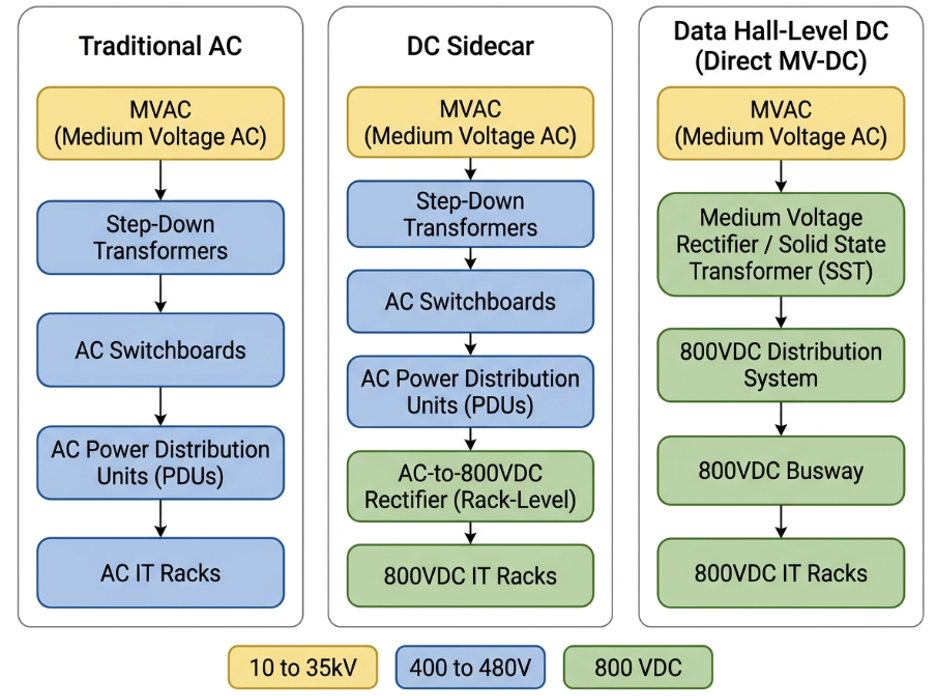
Today’s LV AC Distribution. Existing facilities distribute MVAC power to transformers, step down to 480 VAC, and feed AC AI Accelerator racks through switchboards and AC RPP/busway infrastructure.
A. LVDC Side Power Rack. A dedicated side power rack converts existing 480 VAC to either +/-400 or 0-800 VDC locally, adjacent to the compute racks. The published Mt Diablo +/-400V sidecar spec enables current solutions, while a Mt Diablo 2.0 will be coming later to support native 800V. When sufficient AC power capacity and row space are available, no upstream electrical infrastructure changes are required. This is the fastest path to 800 VDC capability in today’s AI factories.
B. Direct MVAC to 800 VDC Conversion. The long-term architecture uses multiple high-density MW scale transformer rectifiers or solid-state transformer skids to convert MVAC directly to 800 VDC, feeding the entire Data Hall with DC power distribution. By eliminating intermediate AC conversion stages, this architecture enables high-density, modular power blocks for rapid deployment while providing a common 800 VDC backbone for optional Battery Energy Storage system (BESS) integration, DC Uninterruptible Power Supply (UPS) functionality, and future DC microgrids. Direct DC coupling simplifies energy storage integration by removing repeated AC/DC conversions and synchronization requirements, resulting in higher efficiency, greater resiliency, and more flexible power management for scalable next-generation AI factories.
Across both paths, safety engineering is built in from the start. We are leveraging an ecosystem from other industries—including connectors, protection devices, breakers, solid-state breakers that clear faults in milliseconds, and advanced monitoring systems. The design principles being developed in OCP draw on proven approaches from the EV and industrial power sectors, adapted for the specific operating conditions of AI factory environments.
“800 VDC is a foundational architecture for scaling AI factories. By aligning with Google, Microsoft and the OCP Community, NVIDIA is helping accelerate a power infrastructure ecosystem that can support higher compute density, improved energy efficiency and practical upgrade paths for existing AI infrastructure.”.
Vladimir Troy, VP, Data Center Infrastructure / Cloud Infrastructure
An Ecosystem Aligned to Build
More than 80 partners are now developing 800 VDC-compatible infrastructure. We align on the specifications through OCP discussions. Power rack vendors are delivering the hardware for near-term Power Rack deployments. Busbar and connector suppliers are standardizing the DC distribution interfaces. DC-DC conversion specialists are developing the rack-level converters. Facility-level power leaders are building the Transformer Rectifier Units and Solid-State Transformers that future DC-native AI factories will require.
The IEA reports that data center electricity consumption grew 17% in 2025, with AI-focused facilities up 50%, and projects global consumption to nearly double to ~950 TWh by 2030. Wood Mackenzie estimates the infrastructure investment required to meet that demand at $9 trillion through 2040. Building that infrastructure on a fragmented, proprietary foundation would slow the entire industry. Building it on an open, standardized 800 VDC architecture accelerates everyone.
Join Us
We are publishing technical specifications and equipment requirements through OCP so that operators, equipment manufacturers, and facility developers across the industry can participate, build, and deploy with confidence.
AI infrastructure is scaling at a pace and density the industry has never before encountered. Power distribution is the foundation that either enables that scale or limits it. Through our collaboration within OCP, we are making sure it enables it — safely, interoperably, and at the speed the next generation of AI demands.
Learn more: Read the NVIDIA 800 VDC blog and White Paper V2 and explore the OCP LVD working group at [https://www.opencompute.org/community/power-distribution]
if you want to learn more, check out the SST course in the OCP Academy: https://academy.opencompute.org/learn/courses/59/ocp-solid-state-transformers-from-medium-voltage-to-800-vdc